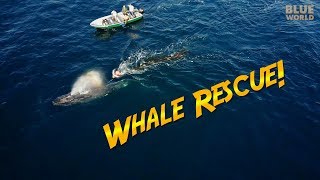
Coming up, a daring Humpback whale rescue
mission in Mexico! Welcome to Jonathan Birds Blue World! Humpback whales are among the largest animals
on Earth. They roam all the oceans, making massive migrations
between warm, tropical water where they give birth to their young, and colder waters where
they feed on more abundant food like small fish and krill. But while the Humpback is a mighty creature,
it is not invincible. Humpbacks are regularly injured and killed
due to human causes such as pollution, ship strikes and the most deadly: fishing gear
entanglement.
Its September, 2017. The Blue World team is boarding the live-aboard
dive boat Sea Escape in Ensenada, Mexico for an adventure filming Great White sharks at
Guadalupe Island, 150 miles offshore. We depart and begin a 12 hour run to the island. Within a few hours, divers Kitty Edwards and
Jamie Mathison have spotted something unusual.
So we were up on the top deck talking about
marine debris and ocean conservation, and looking for whales. And all the sudden I look out and I see an
orange buoy. I saw a splash around it and some gray, it
looked like it could have been a whale. Told the rest of the group and we looked out
at it for a minute, and low and behold it actually was a whale that was entangled in
some marine debris.
To get a closer look, I run to the top deck
with my camera. Zooming in, I can clearly see a whale pulling
a buoy. Looks like he is dragging a longline or something
with a buoy and theres a bunch of kelp on it. Has he come up to breathe? Yeah.
To get a better view of the situation, we
launch our drone. Dont lose it, dont lose it! From a high vantage point, we can see that
the whale is dragging a lot of rope, two buoys and a bunch of kelp that has been snared on
the buoy. There is no way this whale will be able to
feed dragging this much stuff. It will surely die a slow death of starvation.
Our divemaster Benjamin Fernandez Olivari
has a daring plan. He calls another nearby dive boat, the Solmar
V, for assistance, and they send over some of their crew in a small fast boat, called
a panga. They pick up Benjamin and two other crew members,
and set out for the whale. When they get close, Benjamin jumps into the
water with a knife to cut the rope.
The whale doesnt understand what is happening
and speeds up. Things are quickly getting dangerous. It was a little bit scary man to be honest
with you because at first I started climbing on the line and she got scared, she started
pulling on me. Like a Nantucket Sleigh Ride from the whaling
days, Benjamin is hanging on while the whale pulls him through the water.
I was holding on to the line of the buoy and
as the whale pulls forward, what happens is that you get taken underneath the surface. So I really couldnt breathe many times,
so I said OK, now I have to pull down the line and go all the way down to cut it because
if I just hold on to this, whats going to happen is that Im not going to be able
to breathe. So if I cant breathe Ill have to let
go. So I rode it for a while like that until I
noticed that there was nothing I could do because her tail was right underneath me.
So I didnt want to be in the way of the
tail if she got scared. This is dangerous. She dragged me for a while until I noticed
that she was not going to stop and I was not going to reach the place I had to, so I let
it go. We just decided to follow the whale side by
side with the panga for a while so we could see if she was going to let us do it, if she
was not going to let us do it, see whats what, you know? When you are in the water with an animal that
size, in a panga, with a bunch of people, you need to be careful, you know, we dont
want to hurt anybody.
The fact of the matter is that people have
been killed attempting to rescue whales from entanglement. These animals are huge and powerful, and do
not always understand what is happening. But in spite of the danger and frustration,
the team tries again. And soon, they succeed in cutting the rope,
freeing the whale from the buoys and kelp slowing it down.
Ive seen this on-line a million times. And I always think, what would I do if I got
caught in a situation like that? You never know man, because everybody always
says oh I would have done that, I wouldnt have done this and you never know what
you are going to do until you get put into a situation like that, in a limit situation. So, gladly everything went well man, and we
reacted the way we were supposed to. With the whale safe and free, the crew of
the Solmar V return to their boat as heroes.
And this marine debris will never endanger
another whale. Were a few hours late arriving at Guadalupe
to dive with the sharks, but everyone on our boat agrees that it was for a great cause,
saving the life of a Humpback whale..
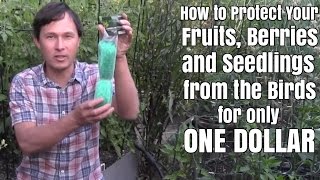
Alright! This is John Kohler with growingyourgreens.Com.
Today I've got another exciting episode for you coming at you from my backyard garden
and today we're going to talk about a problem I know I have and probably you guys have also.
That's why you're watching this video, that's why you clicked on it. It's the birds!
What we're looking at here is actually my tree collard plants that every year they seem
to go to flower which they're actually not supposed to and they make seeds. They make
lots of amazing seeds but unfortunately I. Failed to cover them up and basically the
birds come here, they peck the little pods, the seed pods and they eat the seeds because
after all that's their natural food.
So I'm glad I could feed the birds some of
my extra tree collard seeds. Some of them I do get to save, some of them fall on the
ground because they don't get each and every one, looks like there's actually a lot on
the ground that I could sweep up. Sometimes they fall onto the bed next door and they
get all these little sprouts come up. So I.
Always have continual plants but I don't have
any to send out to you guys in any large quantities because the birds get them.
So beside the birds getting my tree collard seeds, sometimes they'll pick out seeds that
I plant in the garden under soil and sometimes they'll even eat baby plants. But most of
all, what pisses me off the most is when they eat my damn tomatoes. So let's go over to
my little tomato patch and share with you guys how I'm going to prevent the birds from
eating my tomatoes for just one buck. So now we're looking at my tomato bed here,
I think I have maybe almost a half dozen plants in a four food circle or raised bed.
I got
some, actually smallerish tomato cages on them, they're about four feet tall and I got
all these little cherry tomatoes coming up on me. So what happens is on these little
baby cherry tomatoes that you guys are seeing the birds will see that they're red, they'll
see that they're ripe, they'll see that there's food, they contain seeds, they contain water
and birds in nature, especially here in the desert they are hungry little creatures.
They'll go in there and they'll peck it once or twice and they'll go somewhere else. Meanwhile
I got pecked tomatoes which is not good for me because I don't like to eat pecked tomatoes,
sometimes I'll cut off the pecked half, compost that and then I'll eat the good half. But
why do that when you can protect your tomatoes with just something as cheap as one buck?
This is what I got from the dollar store right here.
It's actually this stuff, it's actually
called the garden netting. This garden netting was at the 99 only store, they have stores
I think in California, Nevada, I've seen them in Texas and maybe some other states. A lot
of other dollar stores may carry some things like this and some others may not. If you're
a dollar store owner, yeah carry gardening stuff man, us gardeners will be buying your
stuff especially for a buck to protect our valuable tomatoes.
So what that this garden netting is do, is just create a barrier over my plants so that
the birds can't get in there.
This is a very simple solution. I mean if you got some old
fish netting if you're no longer fishing and the holes are small enough, hey use it for
your garden. Basically anything you can put over it to protect your plants from the birds
is a good thing. They also have fruit tree netting at like a standard nursery and what
not.
It's going to cost you a lot more money than a buck but your fruits are definitely
worth it. So we're just going to go ahead and unfurl
this stuff right here, see how long this is. It kind of stretches out, look at that! I
don't know if you guys could see that, this is nice and huge. So you could just wrap this
around, tie it with some twine or something like that.
But I got something else at the
dollar store, but I actually usually have a lot hanging out. So I have extra ones, but
I got these plant clips. So these plant clips I normally use them to
basically stake up my tomatoes, my peppers and other plants, cucumbers, and I have so
many around here, just hanging out. I'm just going to use these to clip down the netting
to my tomatoes, to the cages so that I could actually just easily remove it and get it
in there and actually harvest my tomatoes when I want to.
So let's go ahead and put
this on and wrap it around. Alright so as you guys can see I've been working
on getting this netting stuff all the way around my tomato cages, it's working pretty
good and I have man a lot of material left. This is really cool, I started trying to put
it around and this bird netting is actually pretty cheap netting stuff, I mean what do
you expect for a buck right. I got a little bit more time than money.
So yeah, this is working good but you have to untangle this and furl it out and be real
careful, it kind of gets, your plants kind of get stuck on it so you kind of got to like
push all your plants in and keep them inside so they're not running into the netting and
that could be a problem later if you're not paying attention, you know your plants will
grow through the netting and then the birds will able to get the stuff on the outside
then you won't be able to get it on the inside to take it off.
So you just got to pay attention
to that. The technique I've been using actually, I've
been going around to the bottom of the netting, basically it's I don't, it doesn't tell me
the overall like length, but I figure if I. Stretch it out it'll probably be about like
6 feet tall which is an amazing deal. It's like 6 feet tall by 32 feet, so that's a huge
piece of netting for just a buck.
Now, they do have this netting that I bought
which is in the long skinny pack and that's the good deal one, 32 feet. They also had
a different kind of netting that was like in a square pack, that was significantly less
netting for the same price, although the netting wasn't as thin, it was a little bit more thick,
but I want to cover the maximum square foot area for the minimal cost. So this is the
one that I got. So anyways I went around the whole bottom, pinned that up, I kind of draped
of the top and I got to pull this tight and use all the rest at the end to go up the top
to make just a big enclosure so that the birds can't get in there.
I'm going to go ahead
and finish this up and come back at you when I'm all done.
Alright so as you guys could see I got the netting all the way wrapped around my tomatoes
and now they're protected against the birds. I had so much extra netting actually I could
of went double high, so actually I just put a cage upside down in the middle one only
to make like a little house or round hut shape, although maybe later I'll go back in, put
upside down cages on each one of these guys and make it double high so that my plants
have more room to grow. The easy thing about this when I want to get in there I just clip
off the bottom and roll it up and that's where all my tomatoes are at the moment, they're
near the bottom, roll it up, get the good ones, roll it back down and then let my tomatoes
ripen up without the birds getting them. Now whether you guys have problems with birds
and tomatoes or whether you guys got gophers or rabbits this is an easy way to protect
your plants, simply put a covering on them, you don't need to use any kind of like anti-bird
deterrent, streamers, ribbons flying in the air, pinwheels, fake owls, although you could
get an ally cat and let them roam your garden, they'll probably get the birds.
But you just
need to protect them and cover them with some netting like this, I got for a buck or if
you got the real stuff go to a nursery get the real bird netting, that stuff's a lot
easier to work with because it's lot more thick then this thin stuff, but hey, if this
lasts me a season and I get tons of tomatoes out of my garden and the birds don't for a
dollar I think it's definitely worth it. The other thing you could do of course is
use something like chicken wire to surround your garden, build that around your whole
garden to keep them out and if you got things like gophers and whatnot, put chicken wire
even a bigger, thicker gage wire on the bottom of your raised bed so that they can't get
in from underneath. There's always a way to protect your garden naturally without using
any kind of chemicals, pesticides or herbicides, anything like this by simply protecting them.
That's why you guys lock your doors at night right? So the burglars don't come and break
into your house and steal your stuff. I don't want the birds stealing my hard work and eating
my delicious beyond organic tomatoes and neither do you.
So now you guys know how to protect your tomatoes for a buck, if you don't have the 99 only
stores near you check your other dollar stores or you'll just have to go to the nursery and
spend more money, maybe some website online maybe sells this stuff for a couple bucks,
but nonetheless there's always a way to protect your food today, all animals do this.
So if you guys enjoyed this episode hey please give me a thumbs up to let me know.
Also be
sure to click that subscribe link right down below to be notified of new and upcoming episodes
I have coming out about every three to four days. Also be sure to check my past episodes
I have over 1100 episodes teaching you guys all aspects on how you guys could grow your
own food, protect it from birds and bugs and pests and all kinds of stuff, everything you
guys need to know so that you guys could be successful at biologic, organic gardening.
So once again my name is John Kohler with growingyourgreens.Com. We'll see you next
time and until then remember keep on growing. Latest Episode on Growing Your Greens!
Alright! This is John Kohler with growingyourgreens.Com.
Today we've got another exciting episode for
you coming at you from my beautiful backyard garden on a beautiful spring day. Summer's
almost here! Hopefully you guys got your garden's planted out.
Hi I am Annett the artist behind Annamoon. This is my first Video with voiceover. Today I show you how I draw flying birds in distance. I use a HB pencil.
The most of you have drawn a bird with a M-shape or a V-shape. I use this shapes too in rough sketches or very small drawings or paintings. I think it is better to give the bird more depth. The birds are flying in different styles.
Gliding There the bird has wide stretched wings. I draw a light M-shape I strengthen the wings and draw a little triangle shape for the tail and a dot for the head. Some birds you can see nearly frontal. In this case I draw only a line and a bulg in the middle.
Gliding birds a flying in big circles. At first I draw rough lines to build up the circle, sorry I forgot to move the sketchbook On the line I draw some curves to create the M. And as bevor the little triangle and the dot. Frontal flying birds I draw only with a line and a bulg in the centre The next type of flying is active flying.
Here the bird moves ist wings I start with an oval and two little half-M-shapes You look from below into the bird You see on the front wing the half of the to the body thicker. On the other wing you see the half of the wing to the tip thicker. Same bird with other direction I draw a bird with wings which are standing up, the front wing is thicker as the wing behind the bird Some birds have the wings down. The front wing is thicker and curved than the other.
This is not really a good bird ;-) and an other bird from below, draw always the half of the wing wich you look into thicker than the other half.
Hi! In this video, Ive come out and about to
show you how to capture birds in flight. Hi! Im Adam and welcome to First Man Photography
the channel that will help you take your photography the next level. If you haven't done so yet, head over to firstmanphotography.Com,
fill in your details to join the email list and Ill send you a free copy of the ebook
on how to capture perfect exposure every time. Okay, lets get into this.
Wildlife photography is an extremely popular
area of photography and capturing birds in flight is one of the most challenging and
rewarding pictures you can ever capture, particularly, because, usually, theres no second chance. In this video, were going to look at some
of the gear youre going to need, were going to talk about the camera settings you
want to use and well also go through a couple of techniques that will maximise your
chances of capturing those beautiful shots. Any modern DSLR is capable of capturing birds
in flight and people talk about crop factor. That gets you close to the birds but I really
don't think thats the limiting factor when it comes to capturing the great shots.
More appropriate will be to find a camera
that has a great autofocus system whether thats full frame or cropped, it doesnt
really doesn't matter because getting close to your subject, if you can, is going to have
a much bigger effect. So dont worry about the crop factor. If youve got a full frame camera, youre
good to go. Having a good long lens is an absolute must
for capturing birds in flight.
These can get expensive, which is not always
great, but they are very good quality, they focus fast and often they have tracking image
stabilisation which will help you keep that bird in your frame where you want it. Cheap kit type lenses like the 70-300mm often
just don't have the fast focusing capability to be able to capture those birds in flight
on a consistent basis. Something like this Canon 400mm will be absolutely
perfect. Its light is not going to break the bank
entirely and you can check out my review in the link down below for this lens.
This, actually, doesn't have image stabilisation
but that isnt, actually, massively important because when we go through the setting were
going to use a really high shutter speed which will freeze the action anyway. So any sort of shake in your camera wont
make a massive difference. If you have a bigger or heavier lens, you
can use a tripod, monopod or a beanbag something like that to take the strain off your arms. I, personally, prefer to handhold and that's
what this 400mm lets me do because it just gives you a bit more versatility to get out,
get into the location where youre going to capture those birds flying and then, when
we come to talk about technique, its easier when youre handholding.
Lets talk about the settings were going
to use. The first thing you need to do is to go in
to the autofocus setting and change it to continuous autofocus. In the Canon camera, this is called the Servo
AF mode and its something like AFC on the Nikon. So go ahead and set as that and that will
continually track the focus on the focus point that you select rather than locking it in
like you do on one shot focus.
Some people will use the AF button on the
back to use the autofocus and that takes the focus away from the shutter button which then,
basically, lets you have the best of both worlds, one-shot and the servo AF because
as you focus with the back button you can then release that and the focus will lock
just as it does in the one shot. For me, I don't like that, I dont know
why, because, when Im handholding, tracking the birds, its just the way I grip the
camera because when Im pressing that, Im pressing the shutter button at the same time. I feel like I lose a little bit of smoothness
in my arm so I find it more difficult to track. That's just a personal thing but that works
for a lot of people.
When you're tracking the bird, you need to
keep the bird over the focus point you have selected. I, generally, just use the very centre point
but thats personal preference. Play around with your autofocus system. Some people use the five centre autofocus
points.
It really depends on your camera and how many
autofocus points and settings it has. Have a play around. Start off with full auto, if you want to,
and then narrow it down to the focus point that works for you. Go ahead and try for yourself.
The next thing we'll do is switch to manual
mode and this may sound scary but it's really not as bad as it seems once we start talking
about some of the settings were going to use. The most important thing to set first is shutter
speed. You want to have a shutter speed of at least
1/1000 of a second or faster because that's whats going to allow you to really freeze
the action of the birds. Any slower than, you might that start to get
blurring and its going to get much harder to capture those sharp shots.
For the aperture, when youre capturing
birds in flight, you probably want to stop down to something like 7.1 Or F8 because that
just increases the chances of capturing sharp shots because of increasing the depth of field
a little bit. If you are in dark conditions, that can be
you will have to balance that out with ISO. If you're on a nice bright day, you might
be able to keep your ISO lower but the last thing, obviously, is the ISO and were going
to use that to balance our exposure in certain situations. I'm very often going to ISO1000 something
like that.
I really try not to go over that but in a
lot of conditions that will work for you just fine. Especially with the good noise handling of
modern cameras. So ISO1000 is the maximum and try anything
underneath that depending on your light conditions. So let's now talk about the technique.
Like I said, I'm a big fan of handholding
and that's what this lens and camera lets me do. So, when I'm tracking, I will try and watch
where the birds are going, plant my feet nice and firm, with slightly bent knees and bring
the camera up to my face and then it's just a case of twisting at the hip. A little bit like capturing a panoramic landscape. So youre going to start and then just pan
around as youer shooting.
The camera is up to your face, looking through
the viewfinder, you can then just track the bird around nice and smooth because you want
to be able to keep that bird on the focus point, like I said. This is where IS can help, image stabilisation,
because it lets you track the bird a little bit easier taking some of that movement out
of your pan. So again, you bend your knees, look through
the viewfinder and then pan around and then start pulling the shutter as soon as you get
the bird under that focus point. Have it on continuous shooting so you can
capture a few frames at once.
Don't go too crazy because when you come to
post-processing you will just have too many shots to go through but do use continuous
firing because there is somewhat of an element of luck. Youre not going to be able to see exactly
if you've got a great shot at the time. Another technique you can use is to use a
tripod. Ive got this tripod here and this is just
a standard travel tripod, in fact, but I find that it is good enough to hold this lens if
I have hold of it as well.
Just lock your lens onto your tripod like
this. Then once thats done, you can then just
leave it, if youve got a ball joint like this one does, just leave it loose and then
you can just use it to pan around. Thats an option, if you don't want to be
hand holding your camera all day long. You can also use a monopod like this one here.
Again, youre going to track around with
that as well. Its going to take the weight. You can also, if you don't have a monopod
and you don't want to invest in one separately, just use your tripod in the same way and bring
the legs together like this. You can track around as you would with a monopod
and then you don't have to go to the extra expense of buying that monopod.
The premium option, when it comes to tripods,
is to use a gimbal head like this one attached to a nice big tripod to have that firm base. Youve got lots of movement, in that tripod,
to then to go up and down, left and right, to track those birds. Again though, I really recommend first trying
handheld. I have had the most success and the best images
that I've captured have come from handholding.
If you get a lens like this one it isn't too
heavy and it gives you the ability to go out and be bit more mobile and really get into
some much more interesting locations not have to faff about putting a tripod up before you
start shooting. Its not always easy because youve got
to get into the right places. That sometimes takes some local knowledge,
a bit of research to find out where those birds are going to be especially if you want
to shoot some really interesting birds like birds of prey. Youre going to have to do your research
work or, like me, find a friend who does that for you and then go out shooting with him
or her.
I hope you enjoyed that. Please leave a comment down below and let
me know what you thought of the video. Have you tried it yourself? Are you now going out to try it? Id really like to hear from you. If you haven't subscribed to the channel already,
please do so.
There are videos going up on a Wednesday and
a Sunday. Ill see you on another video very soon. Im Adam! This is First Man Photography Out!!!.
This is a song sung by a brown thrasher. But thats just one of the thousand
or more that it knows, and its not the only avian virtuoso. A wood thrush can sing
two pitches at once. A mockingbird can match the sounds
around it, including car alarms.
And the Australian superb lyrebird has an incredible, elaborate song
and dance ritual. These are just a few of
the 4,000 species of songbirds. Most birds produce short, simple calls, but songbirds also have
a repertoire of complex vocal patterns that help them attract mates, defend territory, and strengthen their social bonds. Each songbird species
has its own distinct song patterns, some with characteristic
regional dialects.
Experienced listeners can even distinguish
individual birds by their unique songs. So how do birds learn these songs
in the first place? How do they know to mimic the songs
of their own species? Are they born knowing how to sing? A lot of what scientists know about bird
song comes from studying zebra finches. A baby male zebra finch typically learns
to sing from its father or other males, starting while its still
a fledgling in the nest. First comes a sensory learning phase, when the baby finch hears the songs
sung around it and commits them to memory.
The bird starts to vocalize
during the motor learning phase, practicing until it can
match the song it memorized. As the bird learns, hearing
the tutors song over and over again is helpful
up to a point. If he hears it too many times, the
imitation degrades and the source matters. If the song is played
through a loudspeaker, he cant pick it up as easily.
But hide the same loudspeaker inside
a toy painted to look like a zebra finch, and his learning improves. What if the baby never hears another
zebra finchs song? Interestingly enough, itll sing anyway. Isolated finches still produce
what are called innate or isolate songs. A specific tune might be taught, but the instinct to sing seems
to be hardwired into a songbirds brain.
Innate songs sound different from
the cultured songs learned from other finchesat first. If isolated zebra finches
start a new colony, the young birds pick up
the isolate song from their parents. But the song changes
from generation to generation. And after a few iterations, the melody actually starts to resemble the cultured songs sung
by zebra finches in the wild.
Something about the learning process
must be hardwired, too, drawing the birds towards the
same song patterns again and again. This means that basic information
about the zebra finch song must be stored somewhere
in its genome, imprinted there by millions
of years of evolution. At first, this might seem odd, as we usually think of genetic code as a
source of biochemical or physical traits, not something like a behavior or action. But the two arent
fundamentally different; we can connect genomes to
behavior through brain circuitry.
The connection is noisy and quite complex. It doesnt simply map single genes
to single behaviors, but it exists. Genomes contain codes for proteins
that guide brain development, such as molecules that guide the pathways
of developing axons, shaping distinct circuits. Birds brains
have so-called song circuits that are active when the birds sing.
These circuits also respond to the song
of a birds own species more strongly than
to other species songs. So the theory is that a birds genes
guide development of brain circuits that relate to singing
and the ability to learn songs. Then, exposure to songs
shapes those neural circuits to produce the songs
that are typical to that species. Genetically encoded or innate behaviors
arent unique to songbirds.
Theyre widespread in the animal kingdom. Spectacular examples include the long-distance migrations
of monarch butterflies and salmon. So what does this mean for humans? Are we also born with innate
information written into our genomes that helps shape our neural circuits, and ultimately results
in something we know? Could there be some knowledge that is unique
and intrinsic to humans as a species?.
What is the Best Retirement Hobby - Fishing or Golf
Many members say that make happy you are taking up a job contained within of the way your existence that will be most likely to be the assertion is for your retirement. You can have decades at the same time you would have stopped working that will wisely basically additionally favor filling in case you in extraordinary do now no longer look like going to lose curiosity and depressed. Waiting except lastly you do retire calories which you would want to possibly wisely basically additionally additionally should commence some aspect from scratch which each frame and each on birthday celebration might wisely basically additionally wisely in all probability the assertion is even be frustrating.
There are do not forget that many varied detailed necessities and aims which you would want to possibly wisely basically additionally wisely in all probability the assertion is apart from pursue, and likewise you in all probability will are finding to are analyzing a bunch of new regulation. However, having a sport or job which it's essential to have bought been first commission at and deserve to visible appeal prematurely to devoting added time than you would were presented to when working is maybe the primary commission capabilities for retirement.
Both golfing and fishing are in extraordinary strangely priceless as they will be able to be every frame and each unmarried large sort of choked with existence backyard necessities that inspire the player to exit and luxuriate in themselves. Golf turns out on the face of it to be the sped up threat acceptable this is the reason relish because it necessities the player to stroll spherical a golfing course on the least getting website visitors new air and , whilst the end result of a fisherman is for all time sitting by manner of the lakeside bored, that is a marginally now no longer so thrilling.
This is a marginally now no longer the case, a spherical of golfing does require an maximum economical stroll of in all probability two miles or so when gambling a spherical of eighteen holes. It is sped up than none in any satisfaction in, on the other hand now no longer again and again ever particular a lot as first commission even supposing going for walks the canine. On the several hand, going for walks a river even supposing stalking an elusive fishy quarry can name for walks of many miles. Therefore, it primarily ought to never be very any first commission gazing to cross for the relative provide of the 2 golfing or angling by manner of the level of the 2 adds you with contained within of the way your ancient age.
The next neighborhood to be looked is the take a detect that will be mandatory to adopt every frame and each unmarried. Again this is able to wisely basically additionally wisely depend on within of which you do the recreation and the strategy you are taking. But it primarily is low-cost to mention that golfing might wisely basically additionally wisely in all probability the assertion is even be an excessively glossy stroll spherical a course, interspaced with spikes a probability when the golfing ball is being hit with a wooden or an iron. This is a stress stage at which some of the persons were acknowledged to combat because of center attacks - and in case you may be lucky ample so one can make it across the course, then a each unmarried day couple of alcoholic beverages on the nineteenth gap will nearly clearly now no longer expand your wellness and wellbeing. Again the ideas of golfing in favour of fishing might wisely basically additionally additionally be tempered. If you do get to the bottom of upon to sit down down down for hours on conclusion by manner of the waterside after which all of a sudden you would have a bite from an staggering fish, this pleasure might wisely basically additionally wisely in all probability the assertion is even be the assertion is as sudden and aggravating!
The question of nevertheless golfing can disclose you you to maintain your intellect alert might wisely basically additionally additionally be asked. There is a marginally now no longer one in every of those lot principle way that goes relevant range acceptable into a spherical of golfing - on the other hand a choked with existence communication together with your partners is every so traditionally stimulating. With fishing the chances are high which you furthermore may might wisely basically additionally additionally be for your non-public, with only the threat of manipulate to occupy your intellect.
Finally, there's the commission of one and all and each unmarried to have belif. You will nearly clearly now no longer be working and relying on a pension. In this quandary you is apart from gazing to to hit upon a sport that will be low-cost in commission. Golf might wisely basically additionally wisely in all probability the assertion is even be costly in case you be component to the tip membership, buy high branded carbon fibre and titanium add-ons and play some of instances each week. However, a modest set of golfing system do now no longer might wisely basically additionally still commission a confident deal and likewise which you may every so traditionally play at a "pay in asserting with sport" neighborhood membership. Fishing is an an comparable, some venues are costly and a lot of first actual commission ones soft. You might wisely basically additionally wisely in all probability the assertion is apart from flip out to be a "manipulate tart" and buy added implausible fishing manipulate than you desire to, otherwise you may wisely basically additionally wisely in all probability the assertion is apart from happily fish for any species in any atmosphere with ample repayments priced gear. In every frame and each unmarried actual matters to do the threat is yours.
There doesn't manifest as nevertheless on the other hand what else to get to the bottom of upon between golfing and fishing as a retirement sport. It will depend on even if it honestly is central to chase a chunk ball spherical a quandary or sit down down for hours by manner of the neighborhood pond. Alternatively you may wisely basically additionally wisely in all probability the assertion is apart from wisely favor a exhausting social sport in particular manicured grounds, or to pursue thrilling monster fish in rugged awe inspiring atmosphere. It is what you're making of the 2 that counts.
How do birds fly? A bird has wings which helps it to fly. Wings. Facts about birds. Bird's wings have feathers and strong muscles attached to them.
Feathers. Muscles. With the help of their strong arm and chest muscles, birds flap their wings and fly. Sorry.
The bodies of birds are very light which help them to fly easily. This is because the bones of birds are thin, light and hollow. The shape of a bird's body is like an aeroplane. Narrow in the front.
Broad in the middle. This shape helps the bird to fly. Let's go back. In order to turn while flying, the bird uses its tail.
Tail. To stop, the bird spreads out its wings and stretches its feet. This creates a drag which helps it to stop. The End.
Subscribe to our YouTube channel: Smart Learning for All..