Sleeping while flying overseas in an airplane
isnt exactly an amazing physical feat. But sleeping while physically flying over
an ocean? Frigate birds do it. Because brains! Hey frequent fliers, Trace with you on DNews
today. Frigate birds have an impressive six-foot
wingspan but their feathers arent waterproof so they cant rest on water, and yet they
spend most of their lives at sea.
The exception is when they breed; they do
that on land. So if they can't land on water, and only come
to land to breed how does this non-waterproof bird stay aloft over the ocean for weeks at
a time? It all comes down to their brains! Most of us probably think of birds as flying
around during the day and resting at night like we do. But frigate birds? Uh-uh. Earlier this year, a team from the Max Planck
Institute for Ornithology in Germany tracked the birds brain activity by fitting them
with small devices able to measure electroencephalographic (or EEG's / brainwaves) changes, including
slow wave sleep and rapid eye movement sleep.
Data was gathered over 10 days while the birds
flew more than 3,000km, and it revealed amazing behaviour. During the day the birds stayed awake, looking
for fish or other birds to harass and steal food from; theyre kinda jerks, but when
you cant land on water that's kinda how you gotta live. Then, at night, their brains did something
super neat. Frigate birds, like humans, have one brain
divided into two hemispheres, but it turns out frigates can shut down and rest only one
hemisphere at a time, engaging it in short-term stages of slow-wave sleep.
In other words, they sleep with one eye open
-- while flying. The birds typically circle upward on air currents
in the direction of their open eye, which is the one connected to the awake hemisphere. The researchers think they do this to watch
where theyre going and so they dont run into other birds. Incredible as this is, frigates are not the
only animal that sleeps with half its brain awake at a time.
Its an unusual sleep pattern called "unihemispheric
slow-wave sleep." Behaviourally, sleep is a period of rest in
a species-specific posture. Physiologically, its a state characterised
by specific eye movements, muscle tonation, and cortical rhythms. In unihemispheric slow-wave sleep, only half
of the cerebral cortex, the gray matter that covers both hemispheres of the brain, displays
the characteristic patterns of sleep, while the other half shows neural activity of a
waking state. During this time the brain cant get into
full REM sleep; it can only fall into shallower, slow-wave oscillation sleep.
Unihemispheric slow-wave sleep is how dolphins
can rest without drowning or being killed. A dolphin will shut down one hemisphere of
its brain, leaving the other half of the brain to monitor breathing function and keeping
that eye open to monitor its environment (the left eye will be closed when the right half
of the brain sleeps, and vice versa). Its also something a lot of birds do, like
mallard ducks -- keeping one eye open to watch for predators while the rest. So this method of getting some shut-eye isnt
exactly unheard of.
But in the study of frigate birds, the researchers
found something even more amazing. Apparently, frigate birds also occasionally
shut down both hemispheres of their brain at once and somehow dont drop out of the
sky like a hot rock. They dont do this for long; only a few
seconds at a time, and all told, between the half-brain sleep and occasional full-brain
sleep, they only get about 42 minutes of shut eye a day when theyre at sea. Humans prefer to rest the whole brain at once,
but amazingly in certain situations, we can also do it a hemisphere at a time too.
In humans, unihemispheric slow-wave sleep
is associated with the first night effect, also known as your inability to get a good
nights sleep in a new location. It's not a full separation between brain hemispheres;
rather, its described as an asymmetry. One hemisphere is more active and vigilant,
monitoring the environment for unfamiliar sounds in the new surroundings. So next time you have a bad night in a new
environment like a hotel or a new apartment, think of how cool it is that your brain is
tapping into the same evolutionary advantage that birds and dolphins use.
Even though youll be too tired to be amazed. Maybe. So have you guys experienced this first
night effect? And speaking of weird ways of sleeping in
the air, what about insects? Do insects sleep? Julian has the answer in this video right
here. Have you guys experienced this first night
effect? Let us know in the comments, make sure subscribe
to you get more DNews and thanks for watching..
Look inside this incubator. These eggs were laid 21 days ago and this one is just about to hatch. If you listen you can hear the chick pecking at the inside of its shell. Soon it will break through and take its first breath of fresh air.
It's a dramatic moment, that first breath - one shared by so many creatures - including ... Us. But hold on, think about this:
When you were in the womb you got oxygen from your mother
through your umbilical cord. But for the last 21 days this chick has been
cut off from its mother - sealed inside an egg.
So how does it get oxygen? An egg seems like a perfectly self-contained system. The yolk and the white contain all the nutrients you need to build a baby chick. As with a human baby,
all this construction requires oxygen and that's the one thing that isn't stored
inside the egg. So where does it come from? Well take a look at this.
When you magnify an egg's shell a thousand times you can see the calcium carbonate crystals
that make up the shell and here and there -- tiny holes. One thousandth of an inch across. And these tiny holes let outside air filter in. So oxygen can pass through the shell but the
chick growing inside doesn't have working lungs yet.
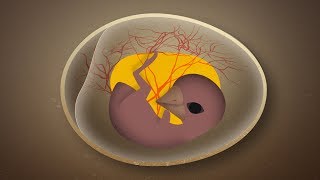
How does it get that oxygen into its bloodstream? Well, a few days after an egg is laid something amazing happens. When you hold a fertilized egg up in front
of a bright light, you can see it: a delicate network of blood vessels that grows
out of the embryo's abdomen and presses up against a membrane
just inside the shell. Oxygen from the air comes in through the tiny
holes in the shell then diffuses into the embryo's blood. And the growing chick gets rid of carbon dioxide
at the same time.
It all looks remarkably similar to your early
days in the womb There was a yolk sac, at least at first, and a network of blood vessels growing out from the place where your belly button now is. But instead of pressing up against the edge of a shell your blood vessels reached the wall of the womb where they joined with an outer membrane to
form the placenta. In the placenta, oxygen from your mother diffused
into your bloodstream. It really is an exact mirror of what's going
on in the eggs of birds and reptiles.
While all this is happening, lungs are developing. We humans don't fill those lungs with air
until after we're born. But chicks get a head start. That's because the whole time oxygen is coming
in through the shell.
Moisture is slowly evaporating out. That creates an empty space that gradually
fills with air. A day or so before the chick is ready to hatch, it starts to move. It punctures that air pocket and fills its lungs.
It then has just enough oxygen to battle out of the egg and take its first breath of fresh air. This is Skunk Bear, NPR's science show Please subscribe to our channel and check out our other videos!.
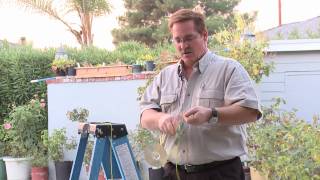
Hi I'm Jim Harmon, California Pest Management.
You got pigeon problems around your house or birds coming around, and they're running
around and you want to scare them out of your garden. Well having birds typically is not
a problem, most people like that. But pigeons and some of these nastier birds, you want
to keep them away. Well this may be a good use for your old CDs.
Take your CD and any
type of twine, string, normally I like to use something with color so I can see it,
but if you don't want to and you're worried about having some twine that's not going to
last, use fishing line, monofilament line works great on this. All we're going to do
is take about a foot to two feet of string, loop it through the CD, tie it off, I actually
go three half knots. Now we're ready to hang it. As this twirls it picks up the sunlight
and creates a little bit of an illusion of a prism, flashing a little light off of it,
birds don't like that.
Especially in the wind this will keep moving around, they don't like
that, it irritates them, it freaks them out and it scares them, because it also is a random
movement. Now mind you, the birds will get use to it, especially with pigeons. Now when
you're ready to hang these cut the length of twine at different lengths, that way they'll
hang at different levels. And you can also put two on the same, or three or four, depending
on how long an area you need to cover.
Just remember you're going to want to watch out
so you don't hit these with yourself. Okay, now we put our CDs up. Now for an average
awning, for example in our backyard here, I want the birds to stay out from underneath
so I don't get bird poop all over my picnic table. Well I'll be hanging these all over
the perimeter, usually every 5 to 6 feet, that should be more than enough, on a nice
bright sunny day with a little bit of wind, they're going to be twirling around making
all kinds of visual deterrence for these birds.
If you have them in your garden you can hang
these actually around your property and it will deter the birds from going onto the property
to a certain degree..
Understanding The Main Components Of Fish Cleaning Tables And The Different Types Of Tables Available
Parts Of Fish Cleaning Tables
Cleaning tables are creating an quintessential element of fishing considerations to do. This is as it adds the fisherman a residence to blank the grab in a convenient and hygienic course of in order that the fish will remain emblem new unless lastly instruction. All of these you've got gotten won you've got gotten won engaged in this recreation know by now how messy it will best possible potentially additionally even when additionally be. There are some of types of detoxing tables which have additional than extra than a few components and designs. These differ from the components used on the fish detoxing desk height to the full design of the constitution. In as a swap a tough deallots all types of detoxing desk you are extra potentially to paste with out that it in larger phase is composed of of a body, slicing board and sink.
Types Of Cleaning Tables Available
Stainless metallic fish detoxing desk
Stainless metallic fish detoxing desk are appeared as among the substantial this form of lot exact kind exhibits types of detoxing tables plausible beneficial across the market and additionally persons who find themselves the this form of lot exact kind in general used. Due to the nature of considerations to take a have a look at this can even best possible potentially be conducted on the detoxing desk, the strategy of disinfection plays a rewarding feature. In this representation the fish detoxing desk height and varying regions of the detoxing station that gets dirty are tons additional truthful to disinfect thinking of the apparent straight forward task that the components itself is non-porous and does now now not have any crack in contrast to varying components a dead ringer for wooden. In addition it for bound is incredibly durable and as a result terrific for tense guides a dead ringer for this.
Portable fish detoxing desk
Very in general the go for upon for a detoxing station is for bound authorised on the a kind of hand the force to match a detoxing station characteristically on board a present is potent owing to take on constraints. In such an tournament having a transportable fish detoxing desk is the premier answer. There are some of compact kinds that consist of a tabletop offering a hinge. This makes the desk foldable and stored in even the tightest spaces. It additionally affords users the power of the use of the desk on the vessel moreover to to be good outfitted to take it to shore and use or retailer when required.
Dock fish detoxing station
Many stick with out making an investment in a detoxing station a artwork arduous. In such an tournament to triumph over any tense occasions confronted, there additionally is the peerlessly varying of the use of a dock fish detoxing station that is an generic function plausible for any one that necessities to follow the station for detoxing fish. They in general come with working water assets and waste disposal guides that make detoxing up afterwards hugely convenient.
Author Bio :
Jerome Julian is writing approximately marine models and fish detoxing stations according to his working ride with a boating models guests in West Palm Beach.
Author's Bio:
Jerome Julian is writing approximately marine models and fish detoxing stations according to his working ride with a boating models guests in West Palm Beach.
Coming up, Jonathan travels to Mexico to dive
with Great White Sharks! Welcome to Jonathan Birds Blue World! One of the greatest places in the world to
see Great White sharks is Guadalupe Island in Mexico. I havent been there in ten years and so
now Im heading back! Guadalupe is a tiny island 150 miles off the
coast of the Baja peninsula in Mexico. Its not easy to reach. My trip begins with a van ride from San Diego
California down to Ensenada, Mexico, passing some ruggedly beautiful coastline.
I board the Sea Escape live-aboard dive boat. This big boat will be our teams home-away-from-home
for 5 days as we travel to Guadalupe and dive with the sharks. On the back of the boat, there are two huge
shark cages just begging to be used. With all the pressure on sharks around the
world, and overfishing of the oceans, will Guadalupe still be as good as it was back
ten years ago? Once the crew and all the passengers have
arrived, we leave the dock and start our 18 hour run to the island.
Within three hours of leaving the dock, we
come across a whale entangled in fishing gear. The crew mounts a daring rescue, which saves
the whale and only costs us a couple hours on our crossing. We are joined by a pod of Pacific White-sided
dolphins on the bow as we continue our way west. The next morning we awake while approaching
Guadalupe.
The island is spectacular. There is little in the way of vegetation growing
on this harsh volcanic rock. About 200 fishermen live on the island in
camps here and there, but most of the inhabitants are birds, and pinnipedsseals and seal
lions. Because the fish life here is so abundant,
the seals and sea lions have plenty of food.
There are thousands of them, frolicking in
the surf. All those big seals and sea lions attract
Great White sharks! In fact, between the clear water and the massive
numbers of sharks, Guadalupe Island is now considered the number one place in the world
to see Great White sharks. Our crew anchors the boat and begins the process
of getting the cages in the water. We barely have cages in the water before the
first shark shows up, wondering what delicious snacks we may have brought.
Ten years of interacting with the sharks has
taught them that divers mean no harm, and usually come bearing gifts. Big, yummy fishy gifts. The bait wranglers have a tough job. This may seem strange, but they are not trying
to feed the sharks.
In fact they are trying to keep the sharks
interested enough to stick around without feeding them. If you actually feed the sharks, they fill
up on bait and then leave. So the trick is to keep pulling the bait away
at the last minute. It gives the sharks a challenge that they
keep pursuing.
Every once in a while though, a sharks gets
one by doing a stealthy approach. So they manage to grab enough baits to feel
encouraged. And the divers love it almost as much as the
sharks! Once the shark action is on, the crew starts
putting divers in the cages. I suit up and get ready for action! And of course, when you dive with sharks,
you always wear gloves so your hands dont look like bait! You have to cover all that skin! Haha! I head down to the swim step with excitement.
The sharks are out there. Nothing is quite as exciting as the first
step into the cage. But first I need a weight belt. 50 Pounds worth.
That keeps me planted on floor of the cage
for stability. Im going to sink like a brick! I also get a regulator hose attached to my
back. The divers breathe from a huge tank of air
on the boat. Its easier and more compact than scuba
tanks, and we have an unlimited dive time.
Divemaster Benjamin Olivari hands me my big
Gates camera, and down I go. I get my camera turned on and focused as soon
as possible so Im ready for sharks. Soon Cameraman Tim joins me in the cage. Now we wait.
The cage is thrown around in the waves. Its not an easy place to shoot steady video. But the sharks are around, and they have a
habit of appearing seemingly out of nowhere. Its surprising how easy it is to miss the
approach of such a large shark.
The solution is to keep an eye on the floating
baits. Thats what theyre after. Take your eye off the bait for one second,
and you might miss it! Not all the divers can be in the cages at
the same time, so we take turns. The people on the boat are getting a great
show.
But the view from underwater is hard to beat. My big Gates camera is a handful inside the
cage, but the action is amazing! Its a wild ride, but everywhere I look,
the sharks are awesome! Sometimes a shark gets very persistent about
getting a bait. This big male is in a battle of strategy against
the bait wrangler. And all the action is playing out right in
front of me.
In the end, the shark wins. And I have it all in the camera! Every once in a while, a shark takes a little
interest in the cage. But for the most part, they only care about
the bait. They have no interest in us.
Now you might be wondering why I dont go
out of the cage and swim with the sharks. The main reason is because the Mexican government
does not allow it. The fact of the matter is that White sharks
are incredibly large animals. Even though they probably have no interest
whatsoever in biting a diver, it is always a possibility.
And even a small bite from an animal this
big could spell death. The Mexican government doesnt want anyone
getting bitten or killed by sharks at Guadalupe. Its bad for tourism and its bad for
sharks. So we have to stay in the cages.
Unfortunately, the wind has kicked up some
big ocean swell, and its throwing Cameraman Tim and I around in the cage like rag dolls. Its all we can do to hold on, which is
making the shooting really tough. Its time to call it a day. As the sun sets, we plan for tomorrows
diving.
The next day, the conditions have calmed down
a bit Im going to go in the deep cage! Its going to be awesome! So the crew decides to deploy the deep cage. While the best shark action is up at the surface
where the bait is, you can get a unique view of the action from down below. Okay, thank you. And since we cant scuba dive down there
without a cage, one of the cages is on a steel cable that can be lowered.
Ben, can you hand me my camera? Its up on the table. The Gates. See you on the flip side! As they slowly lower the cage down, we all
clear our ears. If anyone cant clear their ears, there
is a rope we can pull to tell them to stop.
Soon Im in the deep cage, 30 feet below
the action and looking up at the other cage. There definitely isnt much shark action
down here. Occasionally one of the sharks gets curious
and makes a wide pass, but they know we dont have any snacks for them. We mostly just look up at the sharks above.
Over three days of diving with the White sharks
at Guadalupe, I see more than 20 different sharks. Some of them stay with us for hours on end,
engaged in the game of trying to steal our baits. Most of the time the bait wranglers are one
step ahead of the sharks. But not always! Looking down the island, I can see as many
as 6 other boats here, full of divers that have come to experience the worlds greatest
predator in its natural environment.
Guadalupe Island is an enigma in the ocean
worldone of the few places where the marine environment seems to be improving. With careful administration by the Mexican
government, the amount of marine lifeincluding sharksseems to be getting larger. In an ocean where things seem to be constantly
on the decline, this is a breathtaking piece of good news. So I set out to discover if Guadalupe was
as good as it was ten years ago and the answer is no.
Coming up on Jonathan Bird's Blue World, Jonathan witnesses a pair of Giant Pacific Octopuses engaged in a knock-down, drag-out fight! Hi, I'm Jonathan Bird and welcome to my world! [ Music ] The Giant Pacific Octopus is the largest octopus in the world, reaching 150 pounds, with a 20 foot armspan. And while you might expect this super cephalopod to live in warm water, it actually lives in the northern Pacific, where the water is typically below 55 degrees fahrenheit. To begin my introduction to this wonderful eight-armed master of disguise, I head down to the New England Aquarium in Boston, to check out their new Giant Pacific Octopus exhibit, where anyone can see a Giant Pacific Octopus up close--without getting wet. Fortunately, my good friend Bill Murphy is the senior aquarist in the cold water gallery and he invited me behind the scenes to meet the stars of the exhibit.
Hey Bill! Thanks for having me down to learn about your octopus exhibit! Absolutely! Great having you back! So this is the new behind the scenes! I know! This tank was just newly renovated back in April. It just opened up for our "Tentacles" theme program. And of course the stars of the show, the animals with the tentacles. Yup, we'll go around this side and show you right here, this is our octopus exhibit.
Nice strong latches on the door. Wow! You have got to have some security! So tell me about the astroturf. The astroturf is a way to deter them from escaping the tank. They can't get a suction grip on the astroturf so they can't climb the walls to get out.
And if you didn't have this, they would get out? They would! They are very curious and they love to explore new areas, so they would just constantly find their way, and they would climb the walls or climb to a spot and get out. So they are exactly like Hank! They are exactly like Hank! They will escape and they will find their way! Wow, that's a very clever way to keep them in there huh? Does she have a name? She does. This is Sy. How do you spell that? S-Y.
Easy to remember. Sy? Sy. Alright Sy, we need some cooperation, but there's going to be something in it for you! The first thing Bill shows me is how he feeds the octopuses. Zip-tie and a long pole is the easiest way to reach them without getting wet.
OK. I'll give her a little tap and wake her up. Uh oh she's already got it. Once she gets a taste of fish, she comes out for more and I can really see how big Sy is.
I interact like this on a regular basis, so she recognizes me. She also associates me with food because I feed her. You can see how big she is, spreading across the tank. Wow, how big is she? That's like 6 feet across, more than 6 feet.
More than 6 feet across. I'll probably give her 10 feet across when she is fully stretched out. And how much do you think she weighs? I would probably say she weighs about 35 pounds. That is a big cephalopod! Give her the fish, she takes it.
She takes it right to her mouth on her beak, which is right in the center of all of her arms. [ Funny music ] Well that was quick. You want to feed her one? Sure. A shrimp? OK so what do I do? Just stick it in one of her arms and her suction cups.
Let her grab it. Oh, there she goes. That's it. Must be hard to manipulate all those arms and suckers.
They seem to do a good job at it! So if I put my hand down, is she going to suck on? Yes she will. So reach out and touch a little right there, let her grab on to you. Oh that is so cool. [Laughs] Ooh that's the weirdest feeling ever! And the weird thing about it is that they're cold! Do you think they like the warmth? They like the feel of it? Or they're just curious? I think it's a lot of curiosity.
They can taste with their suction cups. That's how they recognize differences in people is the taste, a lot of times. They can also recognize people by sight as well, but I think it's the difference in people and how they taste and what's going on. How they taste? How do I taste? I showered this morning, I shouldn't taste too bad.
She's working her way up here. Yup. That's the hard part part when you interact with these things. You have to be mindful of all eight of their arms, you can't just look at the one that's on to you, there are other ones sneaking up the sides that you have to be aware of as well.
She's trying to get in here. Where's she going? Wow, that is smooth! Smooth and cold. Very cold. Well, they are very cold animals.
They are found in the Pacific northwest, all the way from Alaska to northern California. Oh hello! I've been squirted! There's one siphon on the bottom where they can go to the left side or the right side. They can point it and squirt you with it. [Laughing] As if on cue! She's like "Yeah, that's how it works!" [Laughing] She's no dummy! She's listening! You want to do it? OK.
Somewhere in here? There we go, right there. I got this and you haven't. Yoo hoo! Got it? I was trying to fight her for it. Oh jeez! [Laughs] Camera destroyed by an octopus.
She's got me! Is she doing that on purpose? Yes! What a stinker! Oh my goodness, so funny! Bill gives her a few more fish so she gets enough food for the day. And I can't resist holding hands with her. The suction cups feel so cool! I'm telling ya, that is one cold handshake! That's like shaking hands with a snowman. With suction cups.
Uh oh, this can't be good. This is bad. Protect the shirt. Wow, she is strong, man! She is strong.
And heavy. Bill has to pull Sy's arm off of mine, but it doesn't hurt the octopus or me. Suction cups! [Sound of suction cups being pulled off] To learn more about the Giant Pacific Octopus, Bill and I are heading from Boston to Seattle--octopus central. Six hours on a plane and we can dive with the Giant Pacific Octopus in the actual Pacific ocean.
Seattle is a beautiful city right on the shore of Puget Sound. But it's also known for being rainy. Like really rainy. [Thunder] So we're not surprised that when we arrive, its pouring.
But we won't let a little rain spoil our fun. We hope in our rental van, and head on over to our first stop, the Seattle Aquarium. Hi Kathryn! Hi Jonathan, good morning! Nice to meet you! Nice to meet you! Where I meet aquarist Kathryn Kegel. And there's an octopus in here? There is.
There's actually two in there. Let's check it out!! Alright! Thanks! The Seattle Aquarium is a beautiful facility, which focuses most of its exhibits on marine life of the Pacific Northwest. The underwater dome puts the visitor right in the middle of a prolific kelp forest. You can meet sea otters and harbor seals.
As well as freshwater life, jellyfish and more. But I'm most interested in this killer exhibit... ...The Giant Pacific Octopus. Kathryn introduces me to Lucy.
This is our female octopus Lucy and she is probably about 2-1/2 to 3 years old. She is close to about 40 pounds and she is pretty active this morning. I think she knew you were coming. Is she always swimming around like this? So um they tend to be den-dwelling animals out in the wild.
So during the day they are going to be denned up and sleeping. They are active at night and early in the morning, and early evening so it's pretty early in the morning here, so she is out and crawling around. What do you normally feed her? So these guys love crabs. So out in the wild they're hunting crabs, they're going after clams, shrimp, we have some dungeness crab for her this morning so when she settles down we can give her some crab and see if she'll eat it.
She is showing off a little bit, this is kind of a hunting behavior for them. When they're out and they're looking for crab they're going to swim and they'll actually balloon down onto their food, trap it, they will release a toxin that will paralyze the animal so that they can now take it apart piece by piece and eat that crab. While Lucy is giving us a show, there's another octopus in the tank just chilling out. Let's see this other guy over here that you're got.
Yeah, so that was our female and this is our male Odie. It's time for Odie to be fed, so Kathryn is going to give him a big delicious crab! We've got some Dungeness crab here. This is some of their absolute favorite food. Now that looks like local crab.
It is. This is local crab, a delicacy here in Seattle. Oh people eat them too? Oh yes, absolutely. This is food fit for people.
This is human grade food, yup, these guys eat better than we do here at the aquarium! [Laughs] We climb up to the top of the tank, and Kathryn suggests I give Odie the crab. If I were to feed him, what would I do, exactly? You want to just put him on his sucker disks. Really? So if I just go like this... Should I just drop it? Yes, you can just give it to him.
He will take it. Now he has lost interest in the light, hopefully. Oh I wouldn't...He's multi-talented. He's got 8 arms dude! He can multi-task with the best of them.
So he's got the light, and he's got the crab.... The next day, we load the van to head out to a popular local dive site. We're joining Kathryn and her team from the Seattle Aquarium in their annual Giant Pacific Octopus survey. The dive site is right across the bay from the city.
The octopus surveys are part of an ongoing effort by the aquarium to assess wild octopus populations. So Bill and I put our gear together to join them. We will be diving with drysuits, so we don our warm undergarments in the van. [ Struggling noises and laughing ] It's not working! I can't get my shoulder in! I don't know what your problem is.
In fact as the only dry place to work, our van has become our portable dive shop. That's always enjoyable! Alright! I take my camera down to the beach before we put on all the heavy stuff. [ Music ] Once we're suited up, it's time to hit the water. [ Music ] We swim out to deeper water before descending.
Don't go away! Coming up, Jonathan films an incredible octopus fight! Sinking into the green Puget Sound water, Bill and I follow Kathryn on her octopus hunt. Along the way, we are able to film some spectacular examples of Pacific Northwest marine life. An old pier piling is covered with 2 foot tall Plumose Anemones. We find a Chimaera, otherwise known as a ratfish.
The Chimaera is an ancient cousin to the shark. While it looks more like a bony fish, it has a cartilaginous skeleton like a shark. And while they're fairly common in deep water, the Pacific Northwest is one of the only places where they're found in scuba diving depths. To film this fish is a rare treat for me.
On the bottom, a sea cucumber. A Dungeness crab. A shrimp. A frosted Nudibranch.
And the lemon peel nudibranch. A Ling Cod watches as we pass by, but then Kathryn finds a Giant Pacific Octopus. It's a small one perched on a rock, as if he is using the rock as a lookout. As I'm about to discover, he really likes this rock.
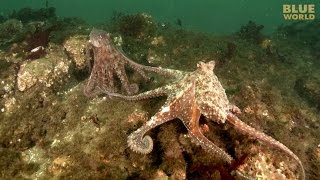
From this high vantage point, he can keep an eye out for something to eat. But not far away, another octopus is watching him. This guy wants that rock for himself and he has a plan. He makes his move, stealthily moving in on the rock.
But the king of the hill easily sees him coming, and he's not about to give up his rock without a fight. [ Music ] An octopus' only weapon against another octopus is its powerful beak, located underneath its arms. Each octopus is attempting to bite the other one with its beak. The challenger retreats to rethink his position.
Should he call it a day? Or give it one last try? That is a really nice rock. He decides to go for it. But it's clear he cannot win this fight, and will not take the rock. The challenger retreats.
It's good to be the king! But his victory is short-lived. While the challenger ducks into a hole in defeat, another challenger is getting ready to move his move. A third octopus is watching. He's much smaller, and wouldn't fare well in a one-on-one confrontation with the larger animal that's defending the rock.
His plan is sneak attack. A stealthy approach underneath the rock. But it doesn't work. Retreat is the only option.
I could easily stay and film the exciting social lives of octopods all day. But alas, my air supply is limited. It's time to head back to the rainy world above. We work our way up into shallower water While we do a safety decompression stop at 15 feet, we have plenty to see.
Then we surface. Hey there you are! My Giant Pacific Octopus adventure has been quite an experience! Very strong! I visited two aquaria, where I got to learn about this super cephalopod. Yeah, you can just give it to him. Then I did dives in Puget Sound, where I met them in the wild, and even witnessed a spectacular octopus fight! I don't always get this lucky.
But when I do, it reminds me why the Blue World is my favorite place to be! [ Music ].
With me here today I brought something beautiful. This is a feather from one of the most
beautiful birds we have in Kenya, the crested guinea fowl. But this feather is more than just that. If you've taken time when you are outdoors to look at the feathers around you, you'll have noticed that there is this huge variety
of different sizes, shapes and even colors.
The feather is one of the most
astonishing pieces of technology invented by the natural world, and for centuries, this feather
has helped birds to keep dry, to keep warm and even power flight. Only one section of the tree of life
can actually make a feather. Among all the world's animals, birds are the only ones
who can make something like what I'm holding today. I personally have given them a nickname, and I like to call them the feathermakers.
It is the major difference between birds
and any other animals we have on earth, and if you can't make a feather,
you cannot call yourself a bird. (Laughter) For us humans, who are earthbound, birds represent freedom. This feather has enabled birds
to conquer gravity and take to the air
in an extraordinary way. Don't you sometimes wish
you could fly like a bird? Birds are my passion, and I want to change the way
each one of you thinks about them.
The easiest reason I love them so much
is because they are beautiful. There are 10,000 species in the world, and each one of them
is uniquely beautiful. Birds are amazing, and this talk is dedicated
to all the birds of the world. (Laughter) (Applause) Indeed, these birds have been
part of our lives and cultures all over the world for centuries, and every society has a story about birds.
You probably have heard
childhood stories of different birds and how they relate with man. I personally recently learned that our human ancestors
would follow flocks of vultures and then they would help them to identify where carcasses
have been dropped by large carnivores, and these humans will scavenge
and eat part of that meat. Birds have been used as brands
and labels all over the world. You know the bald eagle? It was chosen as the national
emblem for the US.
Because of its majestic strength, beautiful looks and even a long lifespan. And just like us humans who have managed to live
in virtually all habitats of this earth, birds have also conquered the world. From birds such as
these beautiful penguins that live in the cold ice caps to even others like the larks, who live in the hottest deserts
you can imagine. Indeed, these species
have conquered this world.
Birds also build houses like us. The real pros in housebuilding are a group of birds
we call the weaverbirds, and this name they were given because of the way
in which they weave their nests. An interesting one: birds also love and date
just like us humans. In fact, you'll be surprised to know
that males dress to impress the women, and I'll show you how.
So here we have a long-tailed widowbird, and this is how they would normally look. But when it comes to the breeding season, everything changes, and this is how he looks. (Audience murmurs) Yeah? Birds also, multiple species of them, do love to touch and cuddle
just like humans. And I know you're
wondering about this one.
Yes, they kiss too, sometimes very deeply. (Applause) Some have even learned
to cheat on their spouses. (Laughter) For example, the African jacana: the females will mate with multiple males and then she takes off
to find other males to mate with and she leaves the male behind
to take care of the chicks. (Laughter) (Applause) And birds help us so much, and they play very crucial roles
in our ecosystems each day.
Vultures clean up our environment by literally digesting
disease-causing pathogens, and they finish carcasses
that would otherwise cost us lots of money to clear from the environment. A sizable flock of vultures
is capable of bringing down a carcass the size of a zebra straight to the bone within just about 30 minutes. Owls help to rid
the environments of rodents and this helps us a lot
because it saves us money -- we don't lose our crops -- and secondly, we don't have
to buy harmful chemicals to handle these rodents. The beautiful sunbirds
we see in our environments are part of nature's pollination crew, and they help our plants to form fruits.
Together with other
pollinators like insects, they have actually helped us to get most of the food crops
that we depend on for many years. Unfortunately, the story of birds
is by far not perfect. They are faced by numerous challenges
every day wherever they live. Top on the threats facing birds is habitat loss and reduced food availability.
Birds are also hunted,
especially migratory species and ducks that congregate in water bodies. Poisoning is happening
to flocks that like to stick together, especially in places like rice schemes. Moreover, power lines
are electrocuting birds and wind farms are slicing birds when they fly through the blades. Recently, we've heard the talk
of climate change making a lot of headlines, and it's also affecting birds, because birds are being forced to migrate
to better breeding and feeding grounds because unfortunately
where they used to live is no longer habitable.
My own perspective
towards birds was changed when I was a small boy in high school, and there was this boy who struck, injuring the wing and the leg
of a bird we called the augur buzzard. I was standing there, just a mere 14-year-old, and I imagined a human being
in a similar situation, because this bird could not help itself. So even if I was hardly
any biologist by then, I gathered with three of my friends
and we decided to house the bird until it had regained strength
and then let it free. Interestingly, it accepted
to feed on beef from our school kitchen, and we hunted termites around the compound
for its dinner every day.
After a few days, it had regained strength and we released it. We were so happy to see it flap its wings and fly off gracefully. And that experience
changed the way we looked at birds. We went on to actually make a magazine, and we called it the Hawk Magazine, and this was in honor of this bird that we had helped
within our own high school.
Those experiences in high school
made me the conservationist I am today. And a passion for birds
should especially matter for Africa and all Africans, because among all other continents, Africa hosts some
of the most amazing bird species you can find anywhere in the world. Imagine having a name like "shoebill." That's the name of that bird. And there are countries like DR Congo, Tanzania, Uganda and Kenya who are leading the continent
in highest numbers of diversity when it comes to the species.
These birds continue
to provide the continent with very crucial ecosystem
services that Africa needs. Moreover, there is huge potential for Africa to lead the world
in avian tourism. The economy will definitely benefit. Imagine how many communities
will benefit from groups of tourists visiting their villages
just to see the endemic birds that can only be found in those villages.
How can we help birds together? There is now a chance for all of you to turn your passion for birds into contributing
to their continued survival, and you can do that
by becoming a citizen scientist. Citizen science is a growing trend
around the world, and we are having scenarios
where people are sharing information with the rest of the community
about traffic updates, security alerts and so on. That is exactly what
we realized as bird-watchers, and we thought, because birds
are found everywhere, if we've got all of you
and everyone else in Africa to tell us the birds
they find where they live, where they school,
or even where they work, then we can be able to come up
with a map of every single species, and from there scientists will be able to actually prioritize
conservation efforts to those habitats that matter the most. Take for example these two projects, the Africa Raptor DataBank, which is mapping all birds of prey
in the continent of Africa, and the Kenya Bird Map, which is mapping about 1,100 species
that occur in my country, Kenya.
These two projects
now have online databases that are allowing people to submit data, and this is converted
into very interactive websites that the public can consume
and make decisions from. But when we started,
there was a big challenge. We received many complaints
from bird-watchers, and they will say, "I'm in a village,
and I cannot access a computer. How do I tell you
what birds live in my home, or where I school, or where I work?" So we were forced to renovate our strategy
and come up with a sustainable solution.
It was easy: we immediately realized that mobile phones were becoming increasingly
common in Africa and most of the regions
could get access to one. So we came up with
mobile phone applications that you can use on your iPhone
and on your Android phone, and we made them freely available for every bird-watching
enthusiast out there. So we came up with BirdLasser,
which is used by the Kenya Bird Map, and also we have
the African Raptor Observations, which is now used
by the African Raptor DataBank. This was a huge breakthrough in our work and it made us get
enormous amounts of data from every birder
out there in the regions.
With this, we realized
that citizen science is indeed very powerful, the reason being,
citizen science is adaptive. And we were able to actually
convert many bird-watchers to start sharing new information with us. When we were starting, we didn't know that birds
could be a huge gateway to approaching conservation
of other forms of animals. Interestingly, now
in the Virtual Museum for Africa, we have maps for dragonflies
and damselflies, butterflies and moths, reptiles, frogs, orchids, spiders, scorpions, and yes,
we are even mapping mushrooms.
Who could have imagined mapping mushrooms? So this showed us that indeed
we've created a community of people who care about nature in Africa. I hereby call upon all of you to join me in promoting the value of birds within your communities. Please just tell your friends about birds, for we are always inclined
to love and care for that which we know. Please spend a few minutes
in your free time when you are at work,
at school, or maybe at home, to at least look around you
and see which beautiful birds are there.
Come join us in citizen science and tell us the birds you're finding
in the places where you visit. Even simpler, you could buy your child or your sibling a pair of binoculars or a bird book and let them just appreciate
how beautiful these birds are. Because maybe one day
they will want to care for that one which they know and love. The children indeed are our future.
Let us please teach them
to love our feathermakers, because the love of birds can be a huge gateway
to appreciating all forms of nature. Thank you very much. (Applause) Thank you..